Source of Wealth Due Diligence for HNW and UHNW Clients: What Wealth Managers Need to Know
Learn how wealth management firms and private banks can conduct effective Source of Wealth due diligence for high-net-worth and ultra-high-net-worth clients.
Source of Wealth Due Diligence for HNW and UHNW Clients: What Wealth Managers Need to Know
Understanding how a high-net-worth or ultra-high-net-worth individual accumulated their wealth is a critical part of effective client due diligence.
For wealth managers and private banks, Source of Wealth (SoW) research provides context that a simple net worth estimate cannot provide. It can help teams understand the economic activities, ownership interests, investments, inheritance and other factors that contributed to a client's overall wealth.
As client structures become more international and complex, Source of Wealth research increasingly requires a combination of financial intelligence, corporate research, reputation analysis and human judgment.
What Is Source of Wealth?
Source of Wealth refers to the origin of an individual's overall wealth.
For an HNW or UHNW client, wealth may have accumulated over many years and through several different sources.
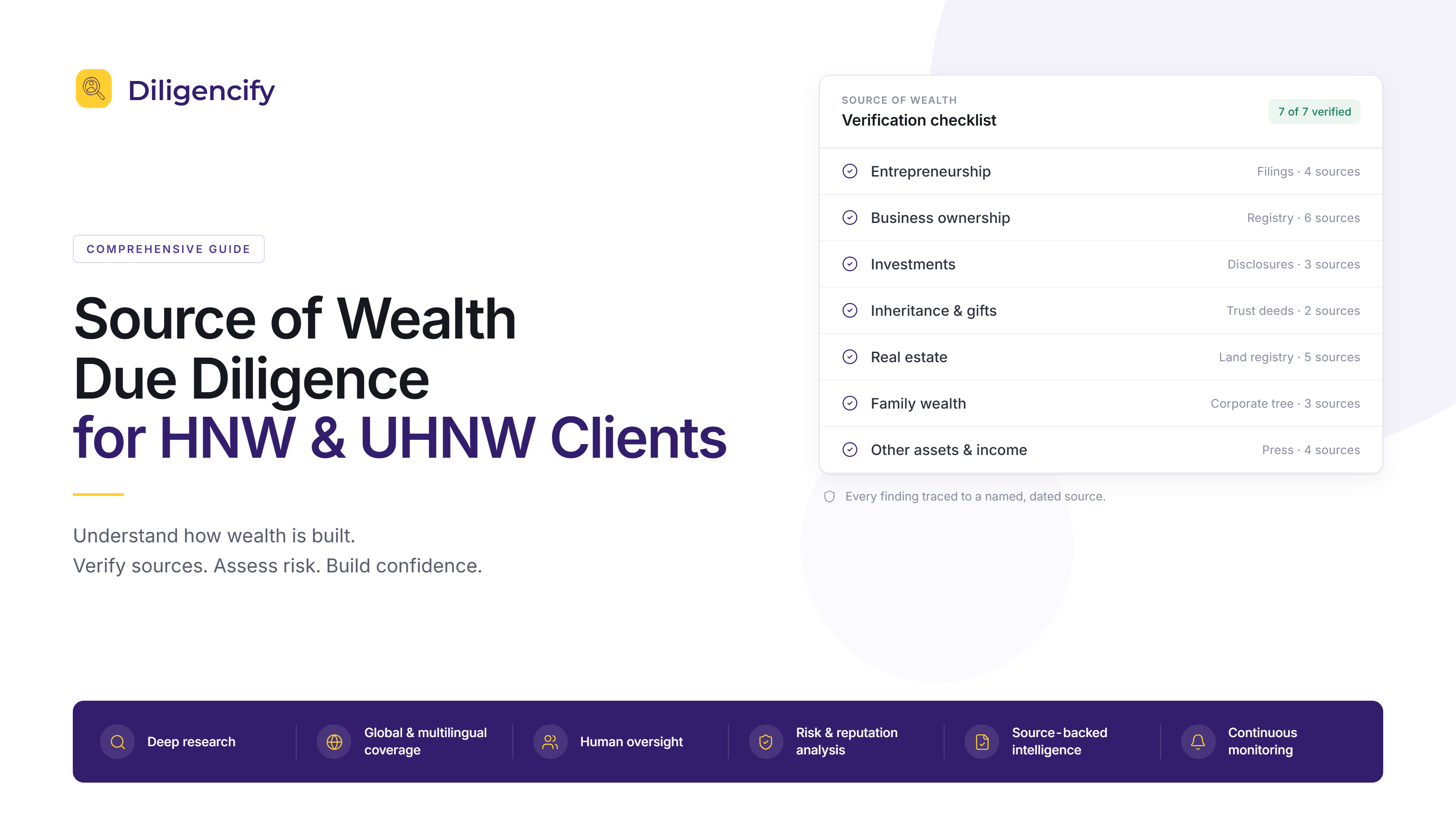
Examples can include entrepreneurship, ownership of private businesses, executive compensation, investment portfolios, real estate holdings, private equity investments, venture capital investments, inheritance, family businesses, dividends and distributions, and professional income.
The objective of Source of Wealth research is to understand the economic narrative behind the client's wealth and assess the available evidence supporting it.
Why Source of Wealth Matters to Wealth Managers
HNW and UHNW relationships can involve substantial assets, international transactions and complex structures. Understanding wealth origin can therefore be an important part of the overall client risk assessment.
Source of Wealth research can help firms build a stronger client profile, support enhanced due diligence, identify potential inconsistencies, understand business and investment interests, provide context for risk assessments, prepare relationship managers for client discussions and support internal compliance reviews.
Source of Wealth should not be treated as an isolated compliance exercise. It can also provide valuable context for client development and relationship management.
Source of Wealth vs Source of Funds
The two concepts are related but different.
Source of Wealth focuses on how an individual's overall wealth was accumulated.
Source of Funds focuses on the origin of the specific funds involved in a particular transaction or relationship.
For example, an entrepreneur may have accumulated wealth through ownership of a technology company. If they later transfer proceeds from the sale of that company into an investment account, the overall Source of Wealth and the specific Source of Funds are related but not identical questions.
Understanding this distinction helps teams structure research appropriately.
Why HNW Source of Wealth Research Can Be Difficult
Source of Wealth research is often challenging because wealth is not always represented in a single public record.
An individual's wealth may be connected to private companies, multiple subsidiaries, investment vehicles, family businesses, trusts and foundations, real estate, public securities, private investments and international jurisdictions.
The analyst may therefore need to connect information from corporate records, regulatory sources, professional histories, news, company websites and other public information.
This is one reason why wealth research can become time-consuming when performed entirely manually.
The Importance of Business History
For entrepreneurial clients, business history can be one of the most important components of Source of Wealth research.
An analyst may need to understand companies founded by the individual, ownership positions, executive positions, board memberships, major transactions, acquisitions, company exits, investments and industry exposure.
The objective is to connect business activity to the broader wealth narrative.
Researching Private Companies
Private companies often present greater research challenges than publicly listed organizations.
Ownership information may be distributed across corporate registries, filings, company websites and other sources. Historical ownership may also differ from current ownership.
For this reason, effective research should consider both current and historical business relationships when appropriate.
Entity resolution is particularly important when individuals or companies appear under different names, abbreviations or transliterations.
The Role of Real Estate and Investments
Real estate and investment activity can form significant parts of an individual's wealth profile.
Depending on available public information, analysts may investigate real estate ownership, investment companies, public company holdings, private investment activity, venture capital participation, private equity relationships and investment partnerships.
The objective is not to assume that every identified asset belongs directly to the individual. Rather, the information should be evaluated carefully and connected to reliable evidence.
Reputation Is Part of the Wealth Story
Source of Wealth research should not happen in isolation from reputation and risk research.
Business success may generate positive public information, but significant controversies, litigation, regulatory actions or allegations may also be relevant to understanding the overall profile.
For that reason, wealth research can be strengthened by reviewing regulatory records, litigation, adverse media, corporate controversies, political exposure, sanctions-related information where relevant, business disputes and professional history.
Findings should be supported by credible sources and reviewed in context.
Source of Wealth for International Clients
International HNW and UHNW clients can create additional research complexity.
A single individual may have citizenship, residence, businesses, investments and philanthropic activities across several countries.
Relevant information may also exist in different languages.
An effective research process should therefore be capable of handling international sources and multilingual information rather than relying exclusively on English-language search results.
Using AI to Accelerate Source of Wealth Research
AI-powered research can help analysts process large volumes of information more efficiently.
Technology can assist with discovering relevant sources, resolving entities, connecting companies and people, identifying wealth signals, summarizing research and structuring findings.
However, AI-generated information should not automatically be treated as verified fact.
Human review remains important, particularly when research may influence a high-value client decision.
Diligencify combines AI-powered research, structured analysis, source-backed intelligence and human oversight to support complex wealth and diligence research. Learn more at the Diligencify homepage.
A Practical Source of Wealth Research Framework
Step 1: Establish the individual's identity
Confirm names, aliases, professional history and relevant geographic connections.
Step 2: Build the business profile
Identify companies, ownership interests, executive roles, board positions and significant transactions.
Step 3: Investigate wealth-generating events
Look for business sales, investments, inheritance indicators, major transactions and other relevant events.
Step 4: Research assets and investments
Review publicly available information about real estate, investments, companies and other wealth indicators.
Step 5: Evaluate risk and reputation
Review regulatory information, litigation, adverse media and other relevant risk indicators.
Step 6: Connect the evidence
Build a coherent narrative explaining the available evidence around the individual's wealth.
Step 7: Document sources
Record the sources supporting important findings so that the research can be reviewed later.
Common Source of Wealth Mistakes
Relying on estimated net worth alone
A wealth estimate does not explain how wealth was created.
Treating one source as definitive
Important information may be distributed across multiple sources.
Ignoring historical information
Current company ownership may not explain how wealth was accumulated.
Failing to distinguish fact from allegation
Reputation research requires careful source evaluation and context.
Ignoring relationships
Business partners, family members and corporate relationships may provide important context.
Not updating research
Client profiles can become outdated as businesses, relationships and circumstances change.
How Source of Wealth Supports Relationship Managers
SoW research can also provide useful intelligence to client development teams.
Understanding a client's business history, interests, investment activity and philanthropic priorities can help relationship managers prepare for more informed conversations.
This creates an important connection between compliance intelligence and client intelligence.
For a broader look at this connection, read Client Due Diligence for Wealth Management.
Conclusion
Source of Wealth due diligence is an important component of understanding HNW and UHNW clients.
The strongest approach goes beyond a single wealth estimate. It combines business history, ownership research, investment activity, assets, relationships, reputation and credible source evidence into a coherent profile.
Technology can significantly reduce the time required to perform this research, but evidence, transparency and human judgment remain essential.
For wealth managers and private banks, better Source of Wealth intelligence can strengthen both risk assessment and the quality of client relationships.
Explore Diligencify to learn more about AI-powered due diligence and prospect intelligence, or continue reading about AI-powered KYC and CDD in wealth management.