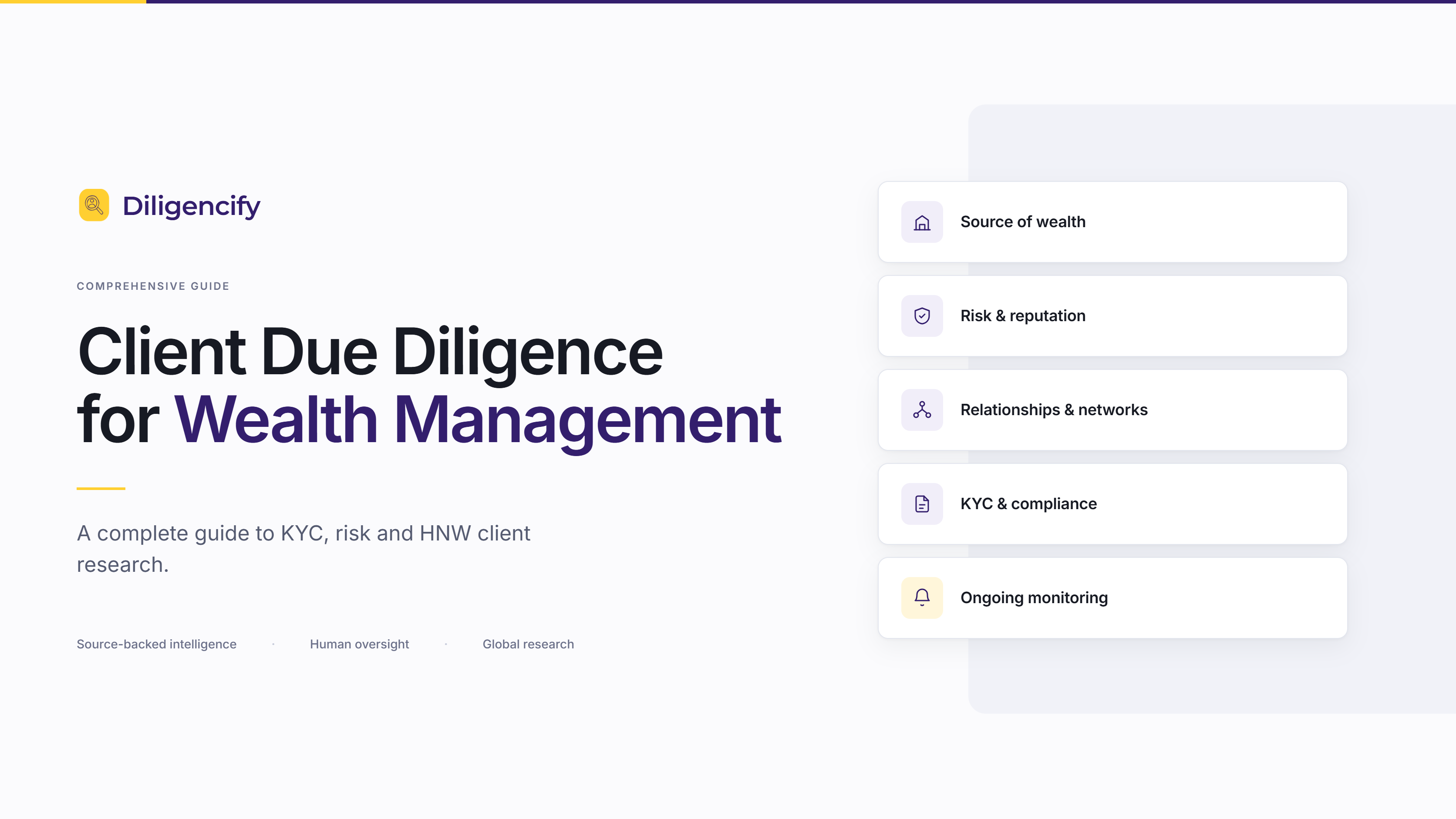
How AI Is Transforming KYC and Client Due Diligence in Wealth Management
Discover how AI-powered research is helping wealth management firms and private banks accelerate KYC, client due diligence, HNW research, reputation analysis and ongoing monitoring.
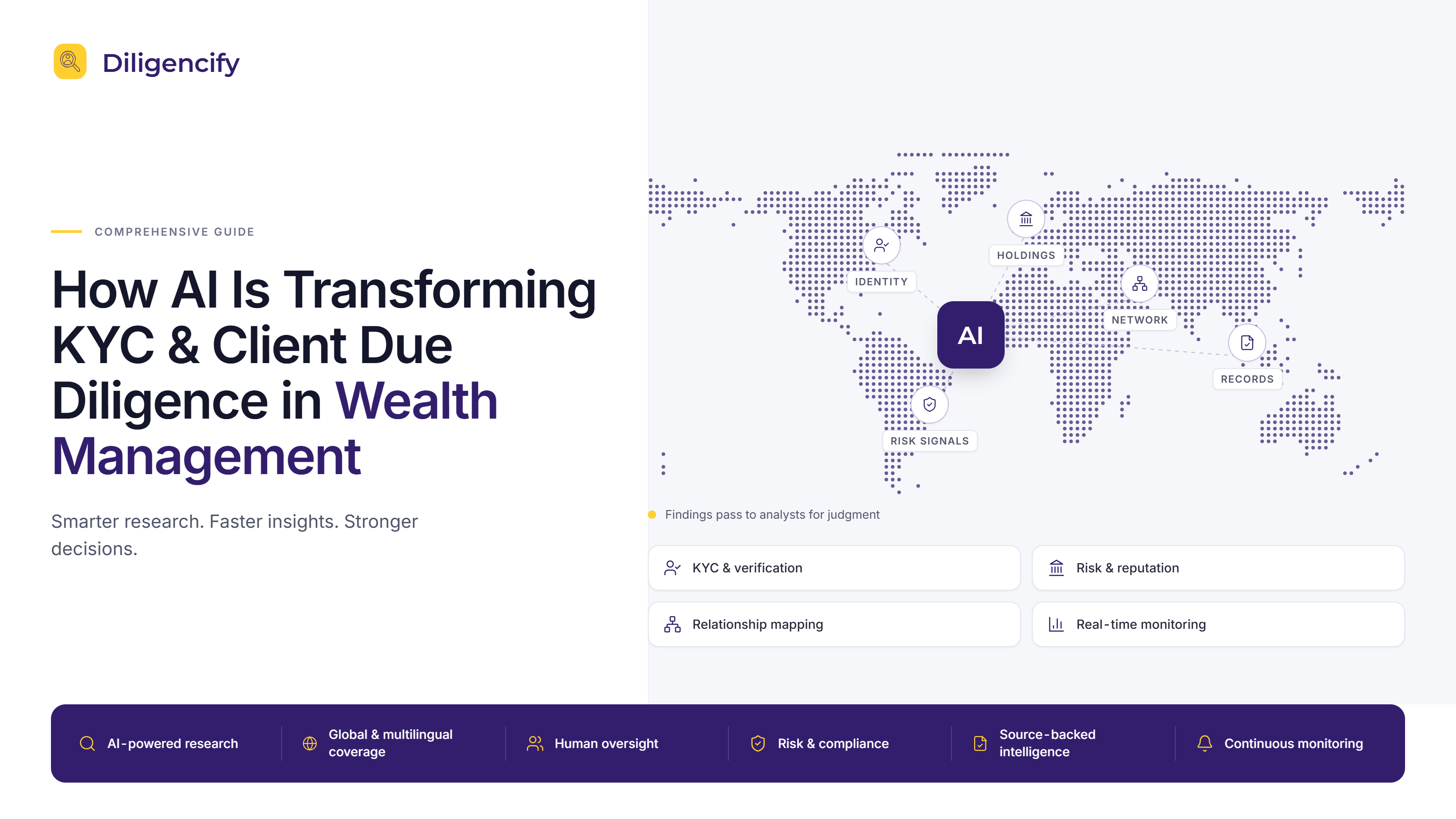
How AI Is Transforming KYC and Client Due Diligence in Wealth Management
Wealth management firms have always needed to understand their clients. What is changing is the amount of information required to do that effectively and the speed at which teams are expected to process it.
For private banks, registered investment advisors, multi-family offices and other wealth management organizations, traditional KYC processes can become difficult when clients have complex business interests, international connections, private investments and significant public profiles.
Artificial intelligence is increasingly being used to support research-heavy activities such as client due diligence, enhanced due diligence, Source of Wealth research, reputation analysis and relationship mapping.
The objective is not to remove human judgment. The objective is to help analysts spend less time searching for information and more time evaluating what the information means.
Why Wealth Management KYC Is Becoming More Complex
Basic identity verification can be relatively straightforward. Complex client research is not.
An HNW or UHNW client may have multiple companies, international business interests, private investments, family offices, foundations, real estate holdings, board memberships, political or public-sector relationships and philanthropic activities.
Information about these activities can exist across corporate records, regulatory sources, news, websites, filings and professional histories.
The challenge is therefore increasingly one of information discovery, connection and evaluation.
What AI Can Do in KYC Research
AI can support several parts of the KYC and CDD workflow.
Information discovery
AI-assisted research can help identify potentially relevant information across large numbers of sources.
Entity resolution
Technology can help determine whether different references relate to the same individual or organization.
Relationship discovery
AI can help identify connections between people, companies, organizations and other entities.
Research summarization
Large amounts of information can be structured into concise research findings for analyst review.
Risk signal identification
AI can help surface potentially relevant regulatory, litigation, reputation or business-risk information.
Continuous research
Technology can help monitor changes after the initial client review.
AI Does Not Replace KYC Judgment
One of the most important principles when using AI for due diligence is that automation should support professional judgment rather than replace it.
AI systems can misunderstand context, connect the wrong entities or incorrectly interpret information. A responsible KYC process therefore needs clear evidence and human oversight.
For high-value client decisions, analysts should be able to understand where information came from, why it is relevant, how entities were matched, whether information is current, whether a claim is verified and whether information represents fact, allegation or commentary.
Source traceability is therefore a critical part of AI-assisted research.
The Difference Between AI Search and AI Due Diligence
A general-purpose AI chatbot can generate useful summaries, but professional due diligence requires a more structured research methodology.
AI due diligence should be designed around the research workflow.
That means the system should help with:
Search — Find potentially relevant information.
Investigate — Examine individuals, companies and events.
Connect — Establish relationships between entities.
Verify — Evaluate source evidence.
Understand — Build structured context.
Monitor — Track relevant changes over time.
This is particularly important for wealth management because the desired output is not simply an answer. The desired output is decision-ready intelligence.
AI and Source of Wealth Research
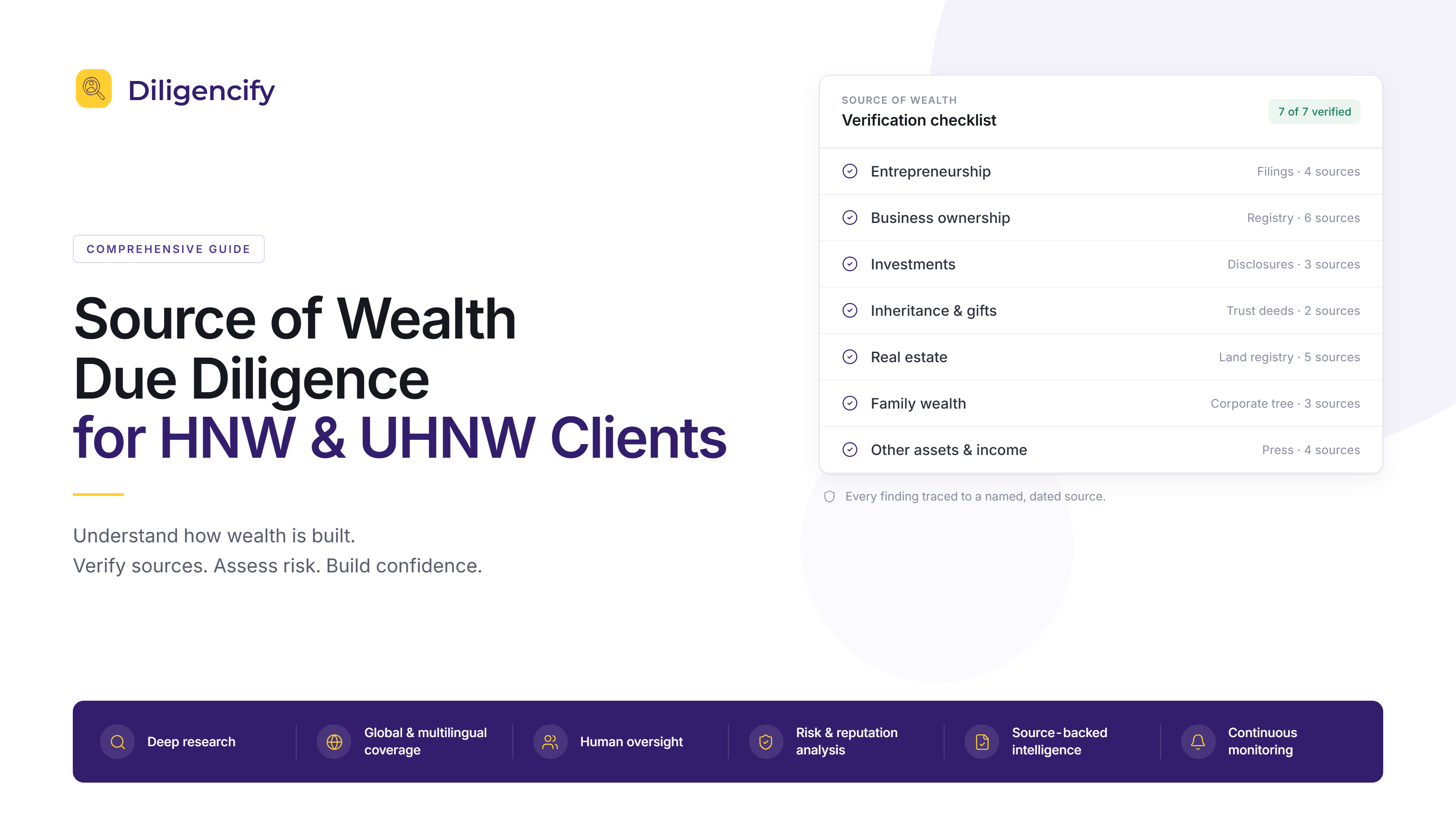
Source of Wealth is one area where AI-assisted research can provide substantial efficiency gains.
For a complex entrepreneur or investor, an analyst may need to research years of business activity, ownership relationships, transactions, investments and other wealth indicators.
AI can assist by organizing this information into a structured narrative while highlighting the sources behind key findings.
For a detailed explanation of the process, see Source of Wealth Due Diligence for HNW and UHNW Clients.
AI and Reputation Risk
Reputation research is another area where AI can help analysts process large volumes of information.
Relevant research may include news coverage, regulatory actions, litigation, business controversies, political exposure and professional history.
The challenge is that not every negative search result represents meaningful risk.
Context matters.
A responsible AI-assisted workflow should therefore help analysts distinguish between relevant information and noise while keeping humans involved in the final assessment.
AI for HNW and UHNW Prospect Research
AI can also support the commercial side of wealth management.
Client development teams may need to research prospective HNW and UHNW individuals before initiating a relationship.
Relevant intelligence may include business interests, career history, investment activity, philanthropic interests, professional relationships, family connections where publicly relevant and areas of influence.
This can help relationship teams prepare for conversations with greater context.
Diligencify positions its research capabilities around both due diligence and prospect intelligence, allowing wealth-focused organizations to investigate risk and understand opportunities through a broader intelligence lens. Visit the Diligencify homepage to learn more.
AI and Relationship Mapping
Some of the most useful intelligence is hidden in relationships rather than individual records.
For example, understanding who sits on the boards of related companies or who is connected through investment and philanthropic activities can reveal useful context.
AI can assist in identifying these relationships at scale.
This makes relationship mapping valuable not only for compliance but also for client development.
Read more in our guide to Prospect Intelligence and Relationship Mapping for Wealth Managers.
Building an AI-Assisted KYC Workflow
Stage 1: Define the research objective
Determine whether the research is for onboarding, periodic review, enhanced due diligence, prospect research or another purpose.
Stage 2: Establish identity
Confirm the individual or organization's identity and relevant aliases.
Stage 3: Research broadly
Search corporate, regulatory, media, professional and other relevant sources.
Stage 4: Resolve entities
Determine which companies, people and organizations are genuinely connected.
Stage 5: Structure the intelligence
Organize findings into wealth, business, reputation, risk and relationship categories.
Stage 6: Review evidence
Verify important findings and evaluate source quality.
Stage 7: Apply human judgment
Analysts and decision-makers interpret the research and determine appropriate next steps.
Stage 8: Monitor
Track relevant changes over time.
The Benefits of AI-Powered Due Diligence
When implemented correctly, AI can provide several operational benefits.
Faster research
Large amounts of information can be processed faster than through manual searching alone.
Greater research coverage
AI can help analysts investigate more sources and connections.
More consistent workflows
Structured research processes can reduce variation between analysts.
Better analyst productivity
Analysts can spend more time evaluating evidence and less time performing repetitive searches.
Scalable intelligence
Organizations can potentially research more prospects and clients without increasing manual effort at the same rate.
What to Look for in an AI Due Diligence Platform
Not every AI research solution is appropriate for high-stakes wealth management workflows.
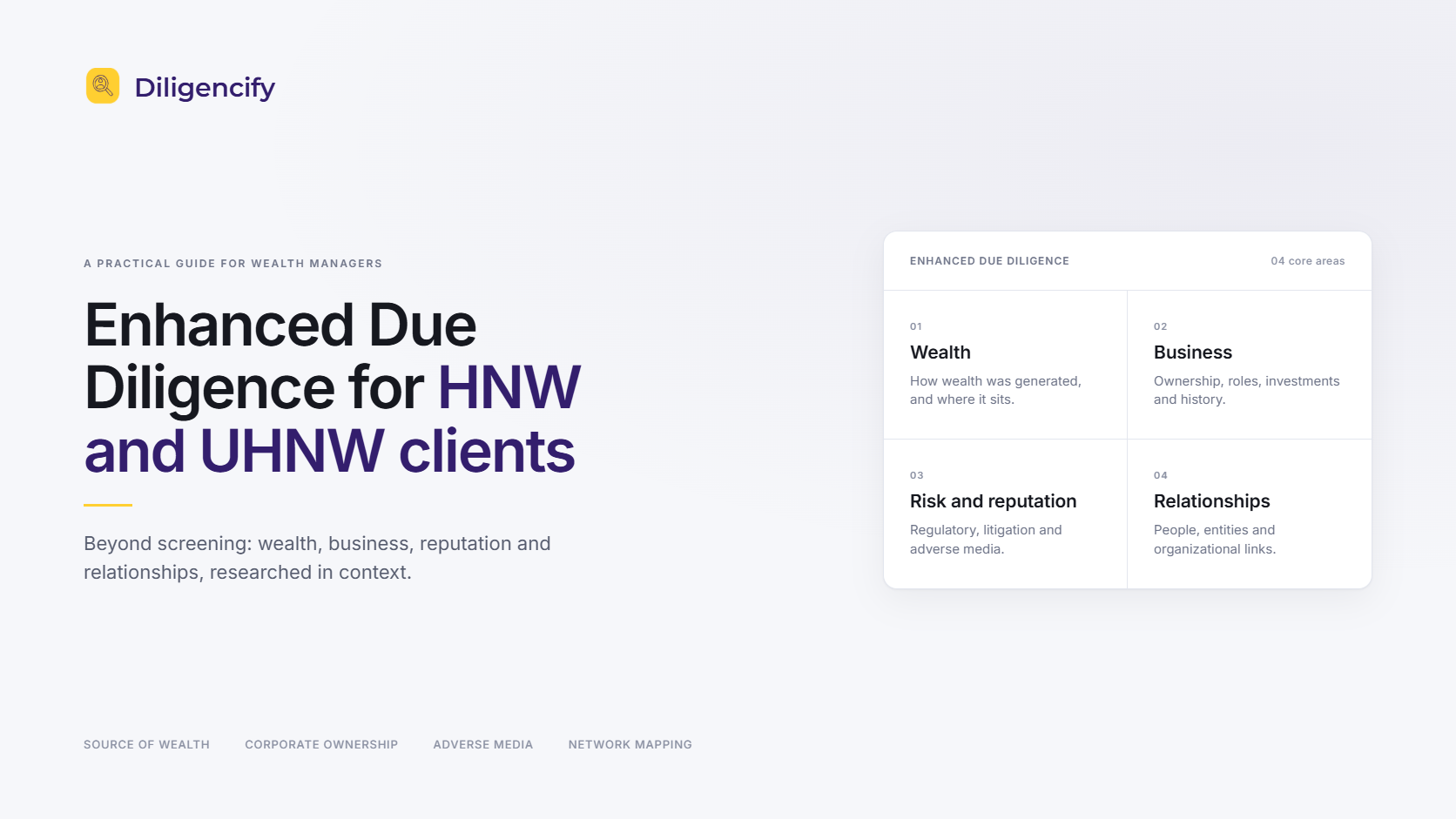
Organizations should consider whether a platform provides source-backed findings, transparent methodology, human oversight, entity resolution, international research capabilities, multilingual research, structured reports, relationship intelligence, monitoring capabilities, appropriate access controls and exportable research.
These capabilities help distinguish professional research infrastructure from generic AI search.
The Future of KYC in Wealth Management
KYC is moving from a periodic checklist toward continuous intelligence.
Instead of researching a client once and leaving the profile unchanged, wealth management firms can increasingly monitor changes in business activity, ownership, reputation, regulatory exposure, relationships and public information.
This approach can help firms maintain a more current understanding of important client relationships.
Conclusion
AI is transforming KYC and client due diligence by helping wealth management teams search, connect, structure and monitor large amounts of information more efficiently.
But AI should not be viewed as a replacement for compliance professionals or relationship teams. The strongest approach combines technology with reliable sources, transparent research and human judgment.
For organizations working with HNW and UHNW clients, this combination can turn fragmented information into structured intelligence that supports better decisions.
Explore Diligencify for AI-powered due diligence and prospect intelligence, then continue with Client Due Diligence for Wealth Management or Enhanced Due Diligence for HNW and UHNW Clients.