Enhanced Due Diligence for HNW and UHNW Clients: A Practical Guide for Wealth Managers
Learn how private banks, wealth managers, RIAs and family offices can approach enhanced due diligence for high-net-worth and ultra-high-net-worth clients.
Enhanced Due Diligence for HNW and UHNW Clients: A Practical Guide for Wealth Managers
High-net-worth and ultra-high-net-worth clients often require a level of research that goes beyond standard identity verification and routine screening.
Complex business structures, international interests, significant wealth, public profiles, political connections and extensive professional networks can create additional considerations for wealth management organizations.
Enhanced Due Diligence (EDD) provides a framework for investigating these relationships more deeply.
For private banks, wealth management firms, RIAs and family offices, effective EDD should combine compliance research with a broader understanding of wealth, business activity, reputation and relationships.
What Is Enhanced Due Diligence?
Enhanced Due Diligence is a deeper level of client research performed when additional information or scrutiny is appropriate because of the client's risk profile, circumstances or relationship.
While standard CDD establishes a foundational understanding of a client, EDD can involve more extensive research into areas such as Source of Wealth, Source of Funds, business ownership, corporate structures, political exposure, regulatory history, litigation, adverse media, reputation, relationships and international activity.
The exact scope should depend on the circumstances and applicable requirements.
Why HNW and UHNW Clients May Require Deeper Research
High wealth itself should not automatically be treated as a risk indicator.
However, sophisticated wealth structures can create greater research complexity.
An individual may have interests in multiple companies, investment vehicles, properties, foundations and jurisdictions. Their professional network may also include business partners, advisors, family members and public figures.
Understanding this wider context can be important when making high-value client decisions.
The Four Core Areas of HNW EDD
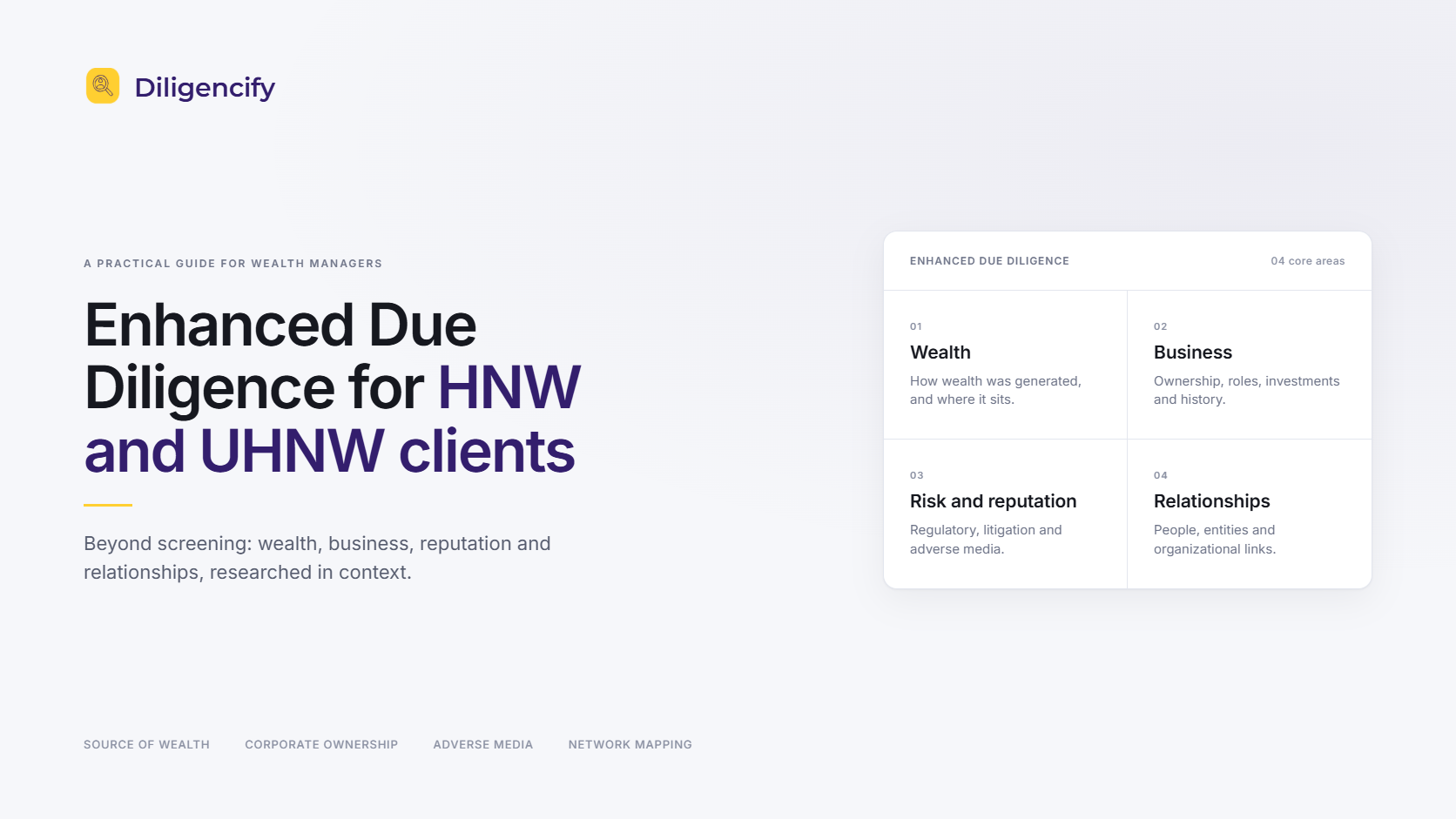
A strong EDD process can be organized around four broad areas.
1. Wealth
Understand how wealth was generated and where relevant assets or wealth indicators are connected.
2. Business
Investigate companies, ownership, professional history, investments and commercial activities.
3. Risk and Reputation
Research regulatory issues, litigation, adverse media and other relevant concerns.
4. Relationships
Understand relevant business, family, professional and organizational connections.
Together, these areas provide a more complete picture than screening alone.
Source of Wealth in Enhanced Due Diligence
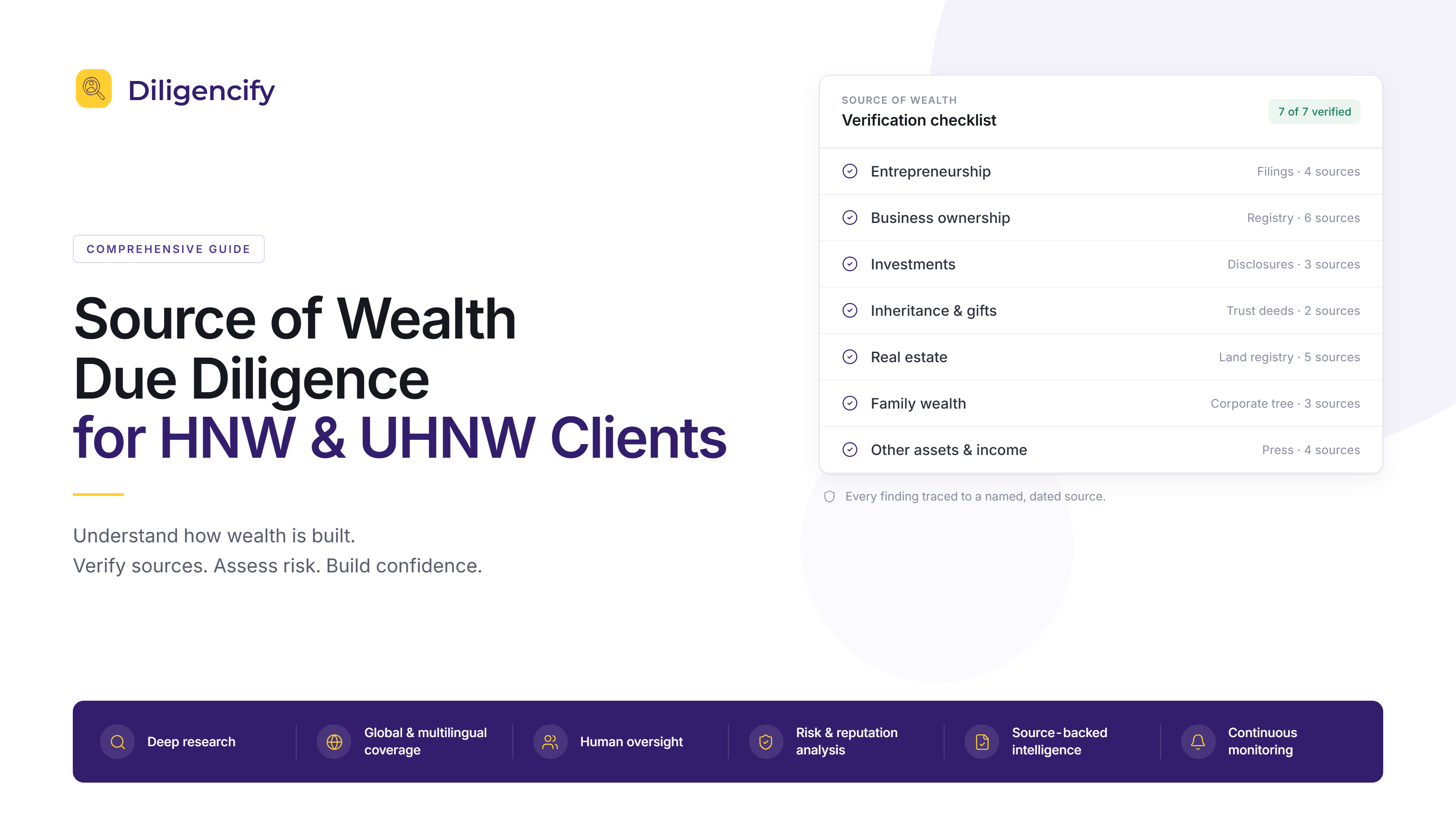
Source of Wealth is often central to deeper research on HNW and UHNW clients.
A wealth estimate provides a measurement. Source of Wealth research provides context.
For example, an entrepreneur's wealth may be linked to ownership of one or more businesses, followed by an acquisition or sale that generated substantial proceeds.
The analyst's task is to investigate the available evidence and establish a reasonable narrative around how wealth was accumulated.
For a detailed guide, read Source of Wealth Due Diligence for HNW and UHNW Clients.
Corporate and Ownership Research
Corporate research is often essential for understanding sophisticated clients.
Relevant information may include current companies, former companies, ownership interests, board memberships, executive roles, subsidiaries, investments, acquisitions, divestitures and business partners.
Historical information can be particularly valuable because current ownership does not always explain how wealth was created.
Reputation and Adverse Media Research
Reputation research is an important component of many EDD investigations.
The objective is not simply to find negative information. It is to determine whether potentially relevant information exists and understand its context.
Research may cover regulatory enforcement, court cases, litigation, business disputes, corporate controversies, professional misconduct allegations, political exposure and negative media coverage.
Analysts should carefully distinguish verified information from allegations and commentary.
Understanding Political Exposure
Politically exposed individuals and their close relationships may require additional scrutiny depending on the circumstances and applicable regulatory requirements.
Research should consider relevant public roles, political connections and associated organizations while avoiding assumptions based solely on a person's position or association.
Context and evidence are essential.
Relationship and Network Intelligence
One of the most valuable aspects of EDD can be understanding relationships.
An individual may have connections to companies, boards, foundations, investment groups, family members and professional advisors.
Relationship mapping can help analysts identify connections that may not be obvious from an individual's primary profile.
It can also help relationship managers understand a prospect's broader network.
For more on this topic, see Prospect Intelligence and Relationship Mapping for Wealth Managers.
International and Multilingual EDD
HNW and UHNW clients frequently have international business and personal connections.
Important information may therefore exist outside the analyst's primary jurisdiction or language.
International EDD may require research across corporate registries, regulatory bodies, court records, local news, government publications, company websites and professional sources.
Multilingual research capabilities can help increase coverage and reduce the risk of relying exclusively on English-language sources.
The Problem With Manual EDD
Traditional manual research can involve opening numerous websites, searching multiple variations of a name, reading long documents, comparing records and manually documenting findings.
This can lead to long turnaround times, inconsistent research depth, duplicate work, analyst fatigue, missed connections and difficulty maintaining current profiles.
Technology can help reduce these operational challenges.
How AI Can Support EDD
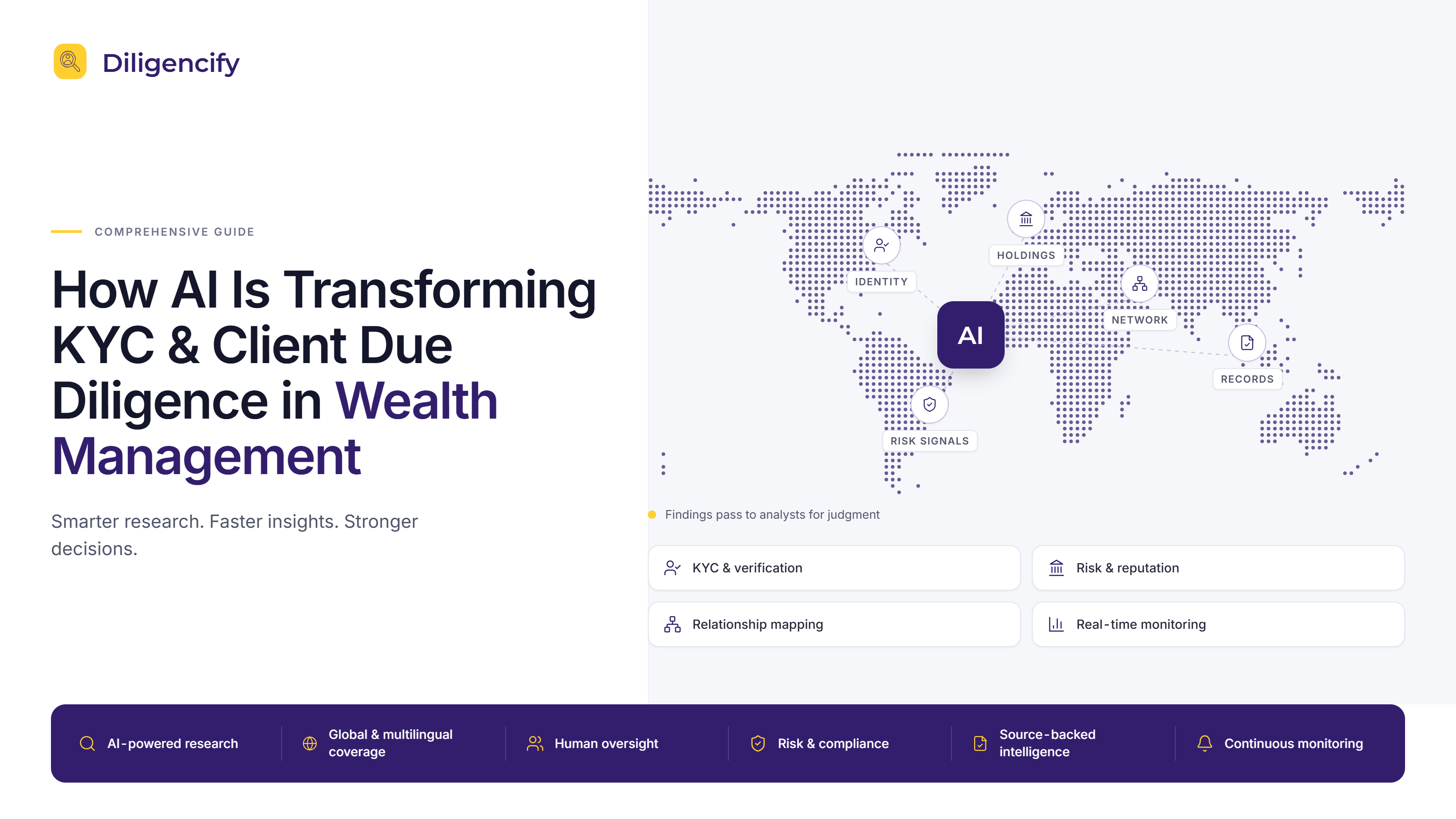
AI-powered research can assist analysts by accelerating information discovery and organization.
Useful capabilities include entity resolution, research automation, source discovery, relationship identification, structured analysis, research summarization, source traceability and monitoring.
However, EDD remains a high-stakes process. Human oversight should remain part of the workflow.
Diligencify combines AI-powered research with human oversight and source-backed intelligence to help organizations investigate HNW and UHNW individuals more efficiently. Visit the Diligencify homepage to learn more.
A Practical HNW EDD Workflow
Step 1: Establish identity
Confirm the individual and relevant aliases, jurisdictions and professional history.
Step 2: Build the business profile
Identify companies, ownership interests, executive positions and major business activities.
Step 3: Research Source of Wealth
Investigate the economic activities and events associated with wealth creation.
Step 4: Investigate reputation
Review regulatory, litigation, media and reputation-related information.
Step 5: Map relationships
Identify relevant connections between people, businesses and organizations.
Step 6: Evaluate findings
Assess the relevance, credibility and context of important findings.
Step 7: Document the research
Create a structured record with supporting evidence.
Step 8: Monitor
Continue tracking material developments when ongoing monitoring is appropriate.
EDD for Client Onboarding
Enhanced due diligence can be particularly important when onboarding high-value relationships.
Relationship teams may want to understand a prospect before the first major meeting, while compliance teams may need deeper evidence before approving or escalating a relationship.
A centralized research process can reduce duplication between these teams.
EDD Should Also Support Client Development
Compliance intelligence can provide useful commercial context.
For example, understanding a prospect's business interests, philanthropic activity and professional network can help relationship managers prepare more relevant conversations.
This is where EDD and prospect intelligence can overlap.
The same research infrastructure can help answer both what needs to be understood from a risk perspective and what needs to be understood to build a better relationship.
How to Improve EDD Efficiency
Wealth management organizations can improve EDD by standardizing research workflows and using technology where it adds value.
Useful improvements include standardized research templates, structured client profiles, source traceability, entity resolution, centralized research, automated discovery, human review, monitoring and alerts, and reusable client intelligence.
These practices can help move EDD from a fragmented manual process toward a repeatable intelligence workflow.
Conclusion
Enhanced Due Diligence for HNW and UHNW clients requires more than screening names against databases.
It requires understanding wealth, businesses, ownership structures, reputation, relationships and relevant developments in context.
AI can accelerate the research process, but the most effective EDD workflows combine technology with credible sources, transparent methodology and human judgment.
For wealth management firms, private banks, RIAs and family offices, the result is a deeper understanding of high-value relationships and better information for decision-making.
Explore Diligencify for AI-powered due diligence and prospect intelligence, or continue with How AI Is Transforming KYC and CDD in Wealth Management.