Prospect Intelligence and Relationship Mapping for Wealth Managers
Learn how wealth management firms and private banks can use prospect intelligence, HNW research and relationship mapping to identify opportunities and prepare for high-value client conversations.
Prospect Intelligence and Relationship Mapping for Wealth Managers
Winning and retaining high-value clients requires more than knowing someone's estimated net worth.
For wealth management firms, private banks, RIAs and family offices, the most valuable prospect intelligence often comes from understanding the person behind the wealth: their business interests, professional history, investments, philanthropic activity, relationships and areas of influence.
This is where prospect intelligence and relationship mapping can provide an advantage.
Rather than treating an HNW or UHNW individual as an isolated record, wealth managers can develop a broader picture of the individual's professional and personal ecosystem using publicly available information and structured research.
What Is Prospect Intelligence?
Prospect intelligence is the process of researching a potential client to understand their background, wealth indicators, interests, relationships, business activity and relevant context before or during relationship development.
For wealth management teams, useful prospect intelligence can include professional history, business ownership, investment activity, wealth indicators, philanthropic interests, corporate affiliations, board memberships, professional networks, family business connections where publicly relevant, and reputation and risk information.
The objective is not simply to collect data. It is to develop intelligence that helps a relationship team understand how to approach a potential client.
Why Wealth Managers Need More Than Wealth Estimates
Estimated net worth can help identify potential prospects, but it rarely tells a relationship manager how to build a relationship.
Two individuals with similar wealth may have completely different business interests, investment preferences, philanthropic priorities, professional networks, geographic exposure, family structures and areas of influence.
Understanding these differences can make prospecting more relevant and personalized.
What Is Relationship Mapping?
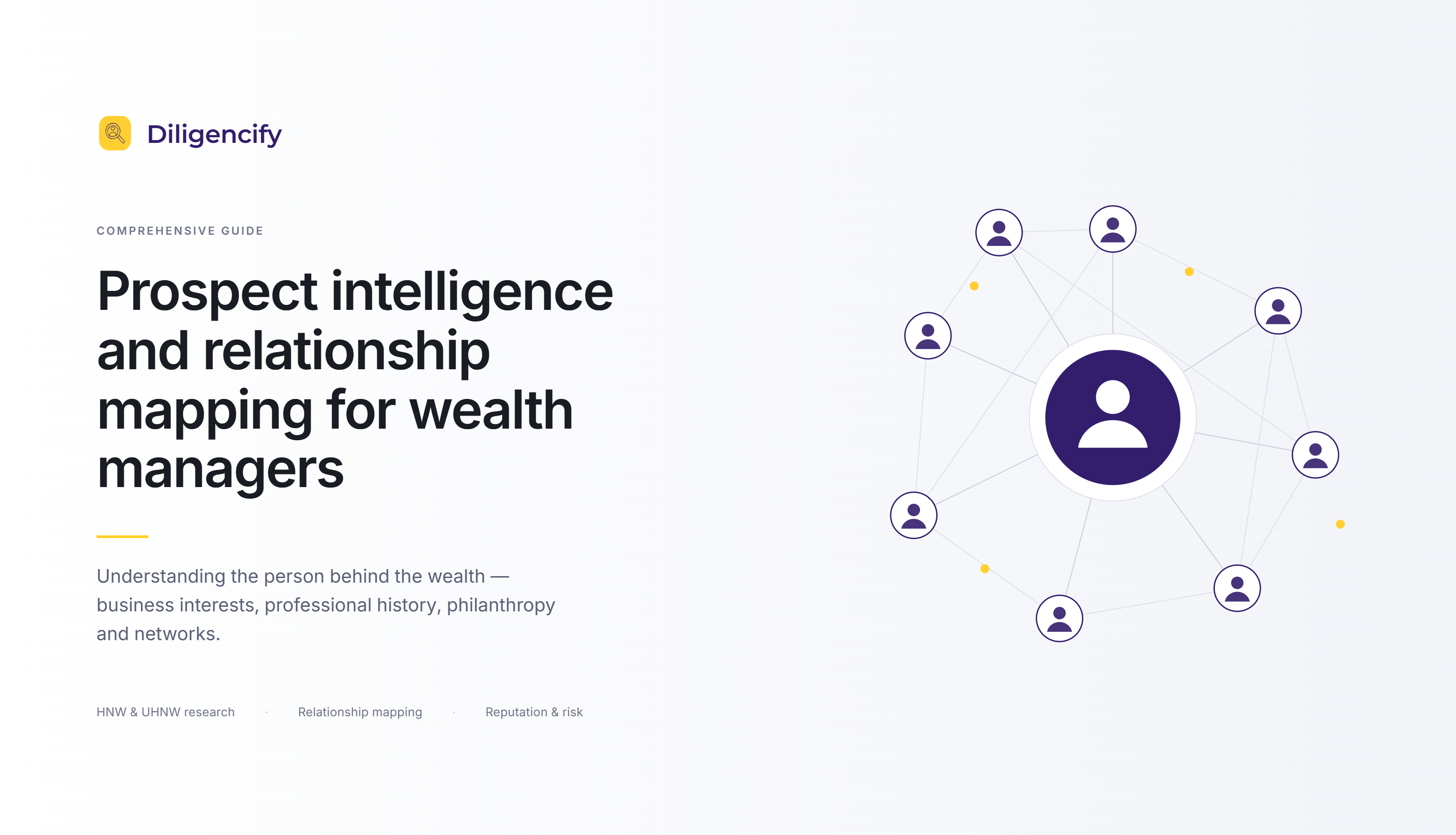
Relationship mapping is the process of identifying and visualizing relevant connections between people, companies, organizations and other entities.
For wealth management, these relationships may include company ownership, board memberships, business partnerships, investment relationships, family businesses, foundations and professional affiliations.
The purpose is to understand the network surrounding a prospect.
Why Networks Matter in Wealth Management
High-value relationships are often developed through trusted introductions and existing networks.
A prospect may already have relationships with existing clients, business leaders, entrepreneurs, investment professionals, lawyers, accountants, family office executives, philanthropic organizations and industry associations.
Identifying relevant connections can help relationship teams understand potential introduction paths and relationship context.
From Prospect Data to Prospect Intelligence
A database can tell you that an individual is wealthy.
Prospect intelligence should help explain why the person may be relevant and how the relationship might be developed.
For example, research might reveal that a prospect built wealth through entrepreneurship, has invested in a particular sector, serves on several boards, supports specific philanthropic causes, has strong relationships within an industry or has recently sold or acquired a business.
Each of these signals can provide useful context for client development.
Researching HNW and UHNW Prospects
Researching high-value prospects can be challenging because public information is fragmented.
Relevant information may exist across corporate registries, company websites, regulatory records, news publications, professional biographies, foundation websites, philanthropic records, public filings and industry publications.
The analyst's job is to connect relevant information into a coherent profile.
Source of Wealth as Prospect Intelligence
Source of Wealth research is not only useful for compliance.
Understanding how someone built their wealth can also provide important commercial context.
An entrepreneur who recently exited a company may have different priorities from an inheritor managing family wealth. An investor active in private equity may have different interests from a technology founder.
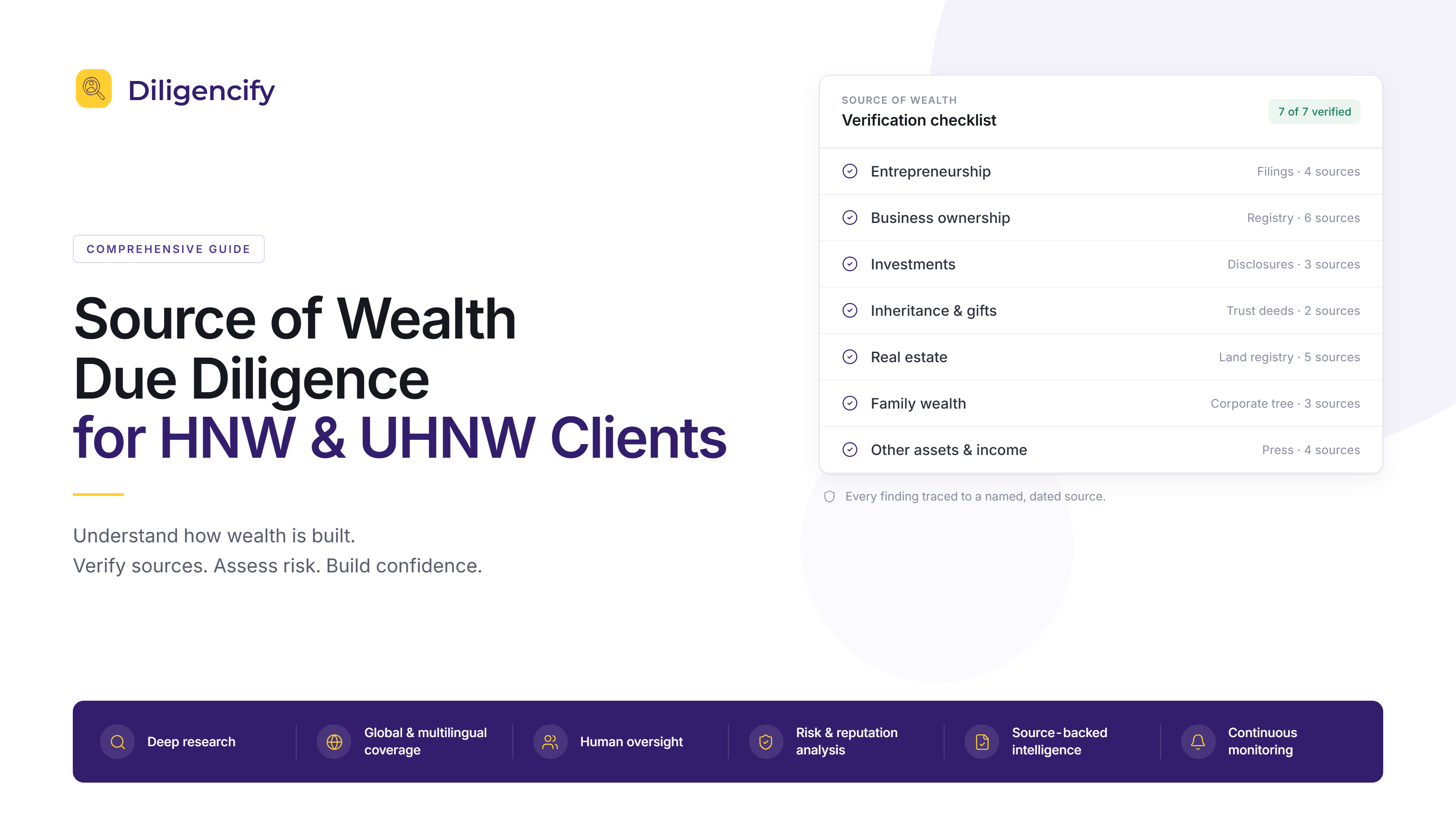
This is why Source of Wealth Due Diligence for HNW and UHNW Clients is an important part of the wider wealth intelligence picture.
Business Intelligence for Relationship Managers
A prospect's professional and business history can help relationship managers understand their expertise, interests and network.
Research can include companies founded, current leadership positions, previous roles, board positions, investments, acquisitions, industry affiliations and major business events.
This information can help teams prepare for conversations with greater context.
Philanthropy and Interests
Philanthropic activity can provide additional insight into a prospect's priorities.
Publicly available information may reveal involvement with foundations, universities, charities, cultural institutions, healthcare organizations, environmental initiatives and community organizations.
This does not mean every philanthropic activity should be treated as a commercial signal. Rather, it can provide useful context when building a relationship.
The Importance of Reputation Research
Prospect intelligence should not focus exclusively on opportunity.
Before pursuing a high-value relationship, firms may also need to understand potential reputation or risk considerations.
Research may include regulatory history, litigation, adverse media, corporate controversies, political exposure and professional disputes.
This creates an important connection between prospect intelligence and due diligence.
Our guide to Enhanced Due Diligence for HNW and UHNW Clients explores the risk side in greater depth.
AI-Powered Prospect Research
Manual prospect research can take hours or days, particularly when researching senior business leaders and UHNW individuals with extensive networks.
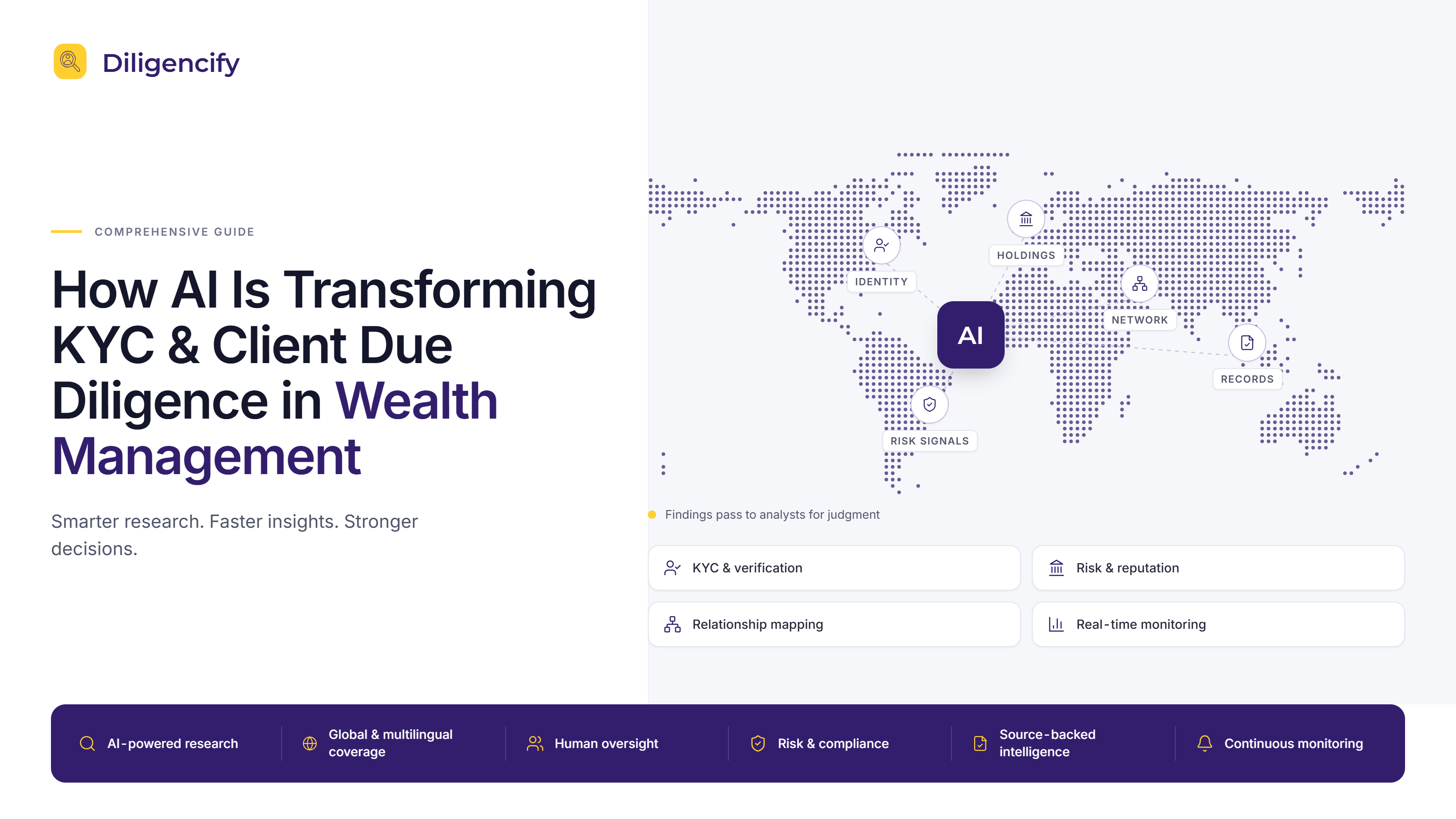
AI-powered research can help accelerate the process by discovering relevant sources, connecting entities, structuring information, identifying relationships, summarizing research and highlighting potential signals.
The objective is to help client development professionals move from raw information to usable intelligence faster.
Diligencify combines AI-powered research with human oversight to investigate wealth, business activity, relationships, reputation and other intelligence relevant to high-value prospects. Learn more on the Diligencify homepage.
Building a Wealth Management Prospect Intelligence Workflow
Step 1: Define the ideal prospect
Identify the industries, wealth characteristics, geography and relationship criteria that matter to the firm.
Step 2: Identify prospects
Build a list of relevant HNW and UHNW individuals.
Step 3: Research the individual
Investigate professional history, business interests, wealth indicators and relevant public information.
Step 4: Map the network
Identify relevant corporate, professional and philanthropic relationships.
Step 5: Assess opportunity
Determine which aspects of the prospect's background may be relevant to the relationship strategy.
Step 6: Assess risk
Review relevant reputation, regulatory and litigation information.
Step 7: Prepare the relationship team
Create a concise, evidence-backed profile that gives the relationship manager useful context before engagement.
Step 8: Continue monitoring
Track meaningful developments that may affect the prospect or relationship.
How Relationship Mapping Can Support Introductions
Relationship mapping can help firms identify potential paths into a prospect's network.
For example, a prospect may serve on the board of a company whose other directors include an existing client. Alternatively, the prospect may participate in a philanthropic organization with an individual already known to the firm.
These connections can potentially create warmer and more credible introduction opportunities.
Any outreach strategy should of course respect applicable privacy, compliance and professional standards.
Prospect Intelligence and Client Due Diligence Should Work Together
One of the strongest opportunities for wealth management firms is to connect prospecting and due diligence workflows.
The research performed before acquisition can become part of the broader client intelligence record after onboarding.
This can reduce duplicated research and create continuity between business development, client development, compliance, KYC, client due diligence and relationship management.
The result is a more connected intelligence workflow.
Measuring Prospect Intelligence Success
Wealth management firms can evaluate their prospect intelligence programs using metrics such as research turnaround time, number of qualified prospects researched, meeting preparation time, introduction opportunities identified, conversion rates, research reuse, analyst productivity and relationship manager adoption.
The objective should not simply be to produce more data. It should be to help teams make better use of the data they already have.
Conclusion
Prospect intelligence gives wealth management firms a way to understand HNW and UHNW prospects beyond estimated net worth.
By combining professional history, business activity, Source of Wealth, philanthropy, reputation and relationship mapping, firms can build richer profiles before engaging with high-value prospects.
AI can make this research significantly faster and more scalable, while human judgment ensures that the resulting intelligence is interpreted appropriately.
For wealth managers, private banks, RIAs and family offices, the combination of prospect intelligence and due diligence can create a more informed approach to both growth and risk.
Explore Diligencify to learn more about due diligence and prospect intelligence, or read our guide to AI-powered KYC and CDD in wealth management.